Literary Device Does Jesus Use When Speaking to Nicodemus About Being Born Again
Nicodemus was an early follower of Jesus Christ, uniquely mentioned only in the fourth gospel, the Gospel of John. According to that gospel, he was a Pharisee and a fellow member of the Sanhedrin (the Jewish Council) in Jerusalem at the time of the trial and crucifixion of Jesus of Nazareth.
The Gospel of John
In the Synoptic Gospels (Mark, Matthew, Luke), Jesus is born man but attained the vindication of the righteous through resurrection and was exalted to Heaven. The Gospel of John is unique because John'due south Jesus pre-existed and was present at cosmos as the logos ("word" or "rationality") who became flesh according to the Christian doctrine of Incarnation. John'south Jesus consistently claimed that he is the only one who has seen the Father, for he is "the ane and just Son, who came from the Begetter" (John 1:14). John'due south gospel utilized the literary devices of metaphor and apologue in the teachings of Jesus: "I am the bread of life" (John vi:48).
John's unique portrait of Jesus is summed upwards in the spoken communication to Nicodemus:
At present there was a Pharisee, a man named Nicodemus who was a member of the Jewish ruling council. He came to Jesus at night and said, "Rabbi, nosotros know that you are a instructor who has come from God. For no one could perform the signs you lot are doing if God were not with him." Jesus replied, "Very truly I tell you, no one can encounter the kingdom of God unless they are built-in once more." "How can someone be born when they are former?" Nicodemus asked. "Surely they cannot enter a 2nd time into their female parent's womb to exist born!" Jesus answered, "Very truly I tell you, no i can enter the kingdom of God unless they are born of water and the Spirit. Mankind gives nascency to flesh, only the Spirit gives nativity to spirit. You should not be surprised at my saying, 'Y'all must exist born once more.' The wind blows wherever it pleases. You hear its audio, but you cannot tell where it comes from or where it is going. So it is with everyone born of the Spirit." "How can this exist?" Nicodemus asked. "Yous are Israel's teacher," said Jesus, "and practise you not understand these things? Very truly I tell yous, we speak of what we know, and we evidence to what we have seen, just withal you people practise not have our testimony. I have spoken to y'all of earthly things and you do non believe; how so will you believe if I speak of heavenly things? No one has ever gone into heaven except the i who came from sky—the Son of Man. Simply equally Moses lifted upwards the snake in the wilderness, then the Son of Man must be lifted up, that everyone who believes may have eternal life in him." For God so loved the world that he gave his i and only Son, that whoever believes in him shall not perish but have eternal life. (John 3:one-16)
John's Jesus appears at the intersection of Heaven and earth. He descended from the Father and will return: "Just as Moses lifted up the serpent in the wilderness, so the Son of Man must be lifted up, that everyone who believes may take eternal life in him." (John 3:fourteen-15) The "Son of Homo" was believed to be a pre-existent angel who was responsible for the final judgement of all humans in God'due south kingdom on world. The word 'crucifixion' does non appear in John's gospel. Rather, his Jesus always referred to his futurity 'lifting up.'
In relation to the ii realms, Jesus contrasts the things from higher up with the things from beneath. In "existence built-in again," the Greek word for 'once more' besides contained a root that meant "from higher up." Punning upon this term, Nicodemus' taking the term literally ("Surely they cannot enter a 2d time into their mother's womb...") represents the denseness of the lack of Jewish agreement of who Jesus is. Whereas the Synoptics blamed the Jewish leadership for the death of Jesus, John's gospel is notorious for his claim that God never intended to save the Jews collectively as a whole (John 8:40-47).
The second mention of Nicodemus is during the Sanhedrin trial of Jesus:
Nicodemus, who had gone to Jesus earlier and who was one of their own number, asked, "Does our law condemn a man without beginning hearing him to find out what he has been doing?" They replied, "Are you from Galilee, too? Await into it, and yous will find that a prophet does not come up out of Galilee." (John vii:l-52)
The third and final mention of Nicodemus is when Joseph of Arimathea (some other believer and member of the Sanhedrin) claims the body of Jesus for burying:
He was accompanied by Nicodemus, the man who earlier had visited Jesus at night. Nicodemus brought a mixture of myrrh and aloes, well-nigh 70-five pounds. Taking Jesus' body, the two of them wrapped it, with the spices, in strips of linen. This was in accordance with Jewish burying community. At the identify where Jesus was crucified, there was a garden, and in the garden a new tomb, in which no one had e'er been laid. Because information technology was the Jewish day of Training and since the tomb was nearby, they laid Jesus there. (John 19:39-42)
The "myrrh and aloes" signifies the belief in the status of Jesus every bit kings of the Jews. These spices were used for the burials of kings.
The Gospel of Nicodemus
The Gospel of Nicodemus has a longer description of Nicodemus' arguments against the Sanhedrin, to spare Jesus' life.
The Gospel of Nicodemus was an counterfeit gospel that appeared quondam in the 4th or fifth century CE. It claimed to be written past Nicodemus and incorporated many details from an earlier apocryphal work, The Acts of Pilate. The Acts of Pilate noted that Pontius Pilate sent a detailed report about the crucifixion of Jesus to the Roman Senate, mentioning Nicodemus. The Gospel of Nicodemus has a much longer clarification of Nicodemus' arguments against the Sanhedrin, to spare Jesus' life (Chapter v).
This gospel contains a fuller version of an before Christian claim (plant in the apocryphal Gospel of Peter), that Jesus descended into Hell on Easter Sat to contend with the Devil for the souls of righteous people who had died earlier Jesus appeared on earth. This story was afterwards absorbed into the Harrowing of Hell. ('Harrowing' was an Anglo-Saxon term for a raid, as in Viking raids in U.k..) Latin manuscripts added a detailed written report by Pontius Pilate to the Roman emperor Claudius (r. 41-54 CE), emphasizing that Pilate was present at the tomb on Sunday morn and was a witness to the resurrection.
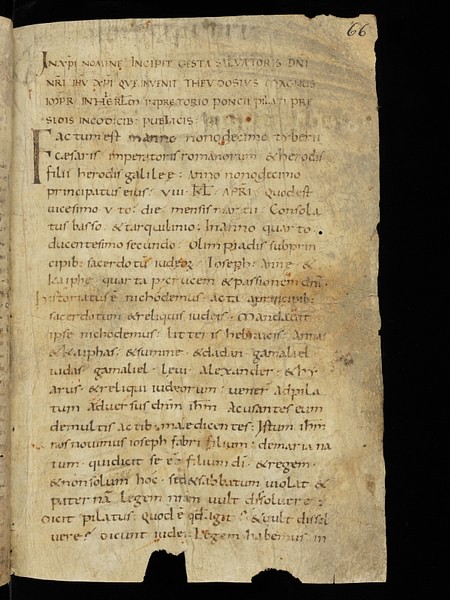
Gospel of Nicodemus
Similar to another text, the Narrative of Joseph of Arimathea, the Gospel of Nicodemus provided the names of pocket-sized characters not found in the New Testament. We learn the names of the 2 men crucified with Jesus, Dismas and Gestas. The centurion who struck Jesus' side with a spear in John'southward gospel is named Longinus. The relic associated with this issue is known as the spear of Longinus and currently resides in Vienna. Nicodemus became a prominent effigy in Renaissance and later on art, in paintings and sculptures depicting the deposition of Christ.
The Protestant Reformation
When Martin Luther'south (1483-1546) reforms established the Protestant Reformation confronting the Catholic Church building, practitioners on both sides were oft subject to persecution and violence. John Calvin (1509-1564) plainly coined the term 'Nicodemite' for anyone who had to live in an oppositional region and survived by hiding their true beliefs (like Nicodemus secretly having to come across with Jesus, Excuse a messierus les Nicodemites, 1544). In opposition to the Catholic Church building elevating Nicodemus to sainthood, Nicodemite became a term of disparagement. These were crypto-Protestants, who publicly professed Catholic beliefs because of their fear of persecution.
Notable accused Nicodemites were: Thomas Cranmer (1489-1556), the kickoff Anglican Archbishop of Canterbury nether Henry Eight of England (r. 1509-1547), and Sir Isaac Newton (1643-1727). The most famous Nicodemite was Michelangelo di Lodovico Buonarroti (1475-1564). Perhaps prepared for his own tomb, the Bandini Pieta (also known as the Florentine Pieta and The Deposition) is a sculpture with four figures: the dead Jesus, Nicodemus (or Joseph of Arimathea), the Virgin Mary, and Mary Magdalene. By tradition, the face under the hood of one of the men is allegedly a self-portrait of Michelangelo.
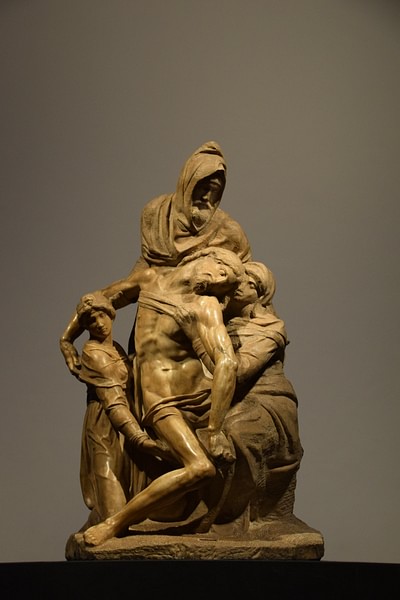
The Degradation
From John three and its use by Paul the Campaigner, some modernistic Charismatic Christians have revitalized the expression 'to be born again' in the acceptance of the ritual of baptism resulting in a new person. In broader cultural and religious terms, Martin Luther Rex, Jr. (1929-1968) invoked the term by claiming that the United States had to be built-in over again to accost social and economic equality (16 August 1967).
In the Catholic Church building, the Eastern Orthodox and Byzantine-rite Cosmic Churches, Nicodemus is recognized as a saint. In the Roman Cosmic agenda of the saints, Nicodemus and Joseph of Arimathea are celebrated on 31 August.
This article has been reviewed for accurateness, reliability and adherence to academic standards prior to publication.
Source: https://www.worldhistory.org/Nicodemus/
0 Response to "Literary Device Does Jesus Use When Speaking to Nicodemus About Being Born Again"
Post a Comment